
The Ultimate Guide: The Best (and Safest) Way to Wash Fresh Eggs
Share
To wash or not to wash? That is the question. If you’ve spent any time at all in homesteading forums or on social media, you’ve probably seen the debate.
You may have heard that you are never supposed to wash your eggs. And maybe you are one whose daily harvest already comes out looking pretty spotless, so you’ve never felt the need.
But the truth is simpler than the internet makes it seem. Today, we have more data than ever before. Between evolving USDA Food Safety Guidelines and a deeper scientific understanding of avian pathogens, the verdict is officially in: properly washing your backyard eggs just before refrigerating or eating is the absolute best way to ensure food safety and preserve peak quality.
Let's dive into the science of the shell, the simple physics of a safe wash, and why different birds in your flock require different care when it comes to clearing away those nesting box nasties.
The Biology of the Eggshell & Understanding the Bloom
To understand why cleaning your eggs is so important, we first have to look at the egg’s natural defense system.
When a hen lays an egg, she applies a wet, protein-based coating called the cuticle, commonly known as the bloom. Within seconds, this coating dries, creating a physical barrier surrounding those eggshells.
The Microscopic Fortress
An eggshell may look completely solid, but it is actually a highly sophisticated, semi-permeable membrane. A single chicken egg has between 6,000 and 8,000 microscopic pores. These pores allow for essential gas exchange. Oxygen enters the egg, while moisture and carbon dioxide exit.
The bloom’s entire job is to filter those thousands of holes to keep harmful bacteria like Salmonella and E. coli from entering the egg.
While the bloom is a total miracle of nature, it isn't a magical force field. If an egg sits in a damp nest box covered in manure, bacteria can eventually breach that filter over time. More importantly, even if the bacteria manage to stay on the outside of the shell, they certainly don't stay there once you crack that egg into a mixing bowl!
The Global Debate: Why the US Washes Fresh Eggs and Europe Doesn’t
One of the most frequent questions we get from flock owners is: "Why do they leave eggs out on the counter in Europe, but we have to refrigerate them in America?"
It all comes down to two entirely different philosophies of food safety:
The European Approach: Many European countries focus heavily on the source of the egg. They mandate the vaccination of laying hens against Salmonella and prohibit the commercial washing of eggs. By keeping the bloom completely intact and the hens vaccinated, they aim to keep the egg safe at room temperature.
The American (USDA) Approach: The US focus is entirely on the surface of the egg. Commercial eggs are washed in high-temperature baths to scrub away all surface contaminants. Because this commercial washing process strips away the natural bloom, the eggs must be refrigerated immediately to prevent new bacteria from entering the now-open pores.
What this means for the backyard homesteader: You actually get the best of both worlds. Unlike mass-scale commercial facilities, you have total control over your flock's environment. But because backyard setups aren't subject to the strict commercial vaccination programs found in Europe, managing surface bacteria is entirely up to you.
When you clean your backyard eggs with a dedicated silicone scrubber and an all-natural enzyme wash right before refrigerating them, you create a personal double-lock safety system. You get the pristine cleanliness of the American standard without relying on harsh commercial chemicals, preserving the ultimate farm-to-table quality.
The Physics of Washing Backyard Eggs
If you take only one thing away from this guide, let it be this: Water temperature is not a suggestion, it is a safety requirement.
When you wash an egg, you must always use water that is at least 20°F (about 11°C) warmer than the egg itself. Why? It all comes down to what we call the ‘Vacuum Effect.’
The Science of Contraction
Inside every fresh egg is a small air cell. When a warm egg is exposed to cold water, the internal temperature drops instantly. This causes the air and liquid inside the shell to contract. That sudden contraction creates an internal vacuum that literally "sucks" some of that water sitting on the surface straight through the pores and directly into the egg. If the surface is dirty, you have just pulled bacteria straight into your food.
The Warm Water Solution: Using warm water (ideally between 90°F and 120°F) causes the internal contents of the egg to expand slightly instead. This expansion creates positive pressure, pushing out against the pores. This ensures that absolutely nothing, not water, not dirt, and certainly not bacteria, can make its way inside your backyard eggs.
Cleaning Different Egg Types
Not all eggs are created equal. Because different poultry breeds have entirely different nesting habits and eggshell biologies, your cleaning routine needs to adapt to the specific bird types in your yard. Here is exactly how to handle the beautiful variety in your flock harvest.
How Do You Clean Farm Fresh Chicken Eggs Safely?
While chicken eggs don't have the thick tacky bloom of a duck egg or the extreme fragility of a quail egg, they are the most frequent victims of everyday coop debris like dried mud, stuck-on straw, and chicken poop.
The Problem: Chicken eggs range wildly in size (from tiny bantams to jumbo double-yolkers). Traditional flat kitchen sponges or harsh green scrubby pads either miss the natural contours of the egg shell entirely or scratch the protective shell, opening up microscopic pores to bacterial invasion.
The Solution: To clean farm fresh chicken eggs without damaging the shell, use a flexible, food-grade silicone egg scrubber combined with an all-natural enzyme wash and always use warm water shooting for that 110°F.
Here is why the GoodEgg® Brush is the most effective tool for your fresh egg cleaning:
- Adapts to All Sizes of Eggs: The GoodEgg brush comes in standard & large sizes for your full flock.
- Protects the Shell: Features hundreds of silicone nubs that gently lift away debris without damaging the shell.
- Prevents Bacterial Contamination: Used with the warm-water rule, it clears surface contaminants and Salmonella risks safely without breaking a single egg.
How Do You Clean Fresh Duck Eggs Safely?
Duck eggs feature a significantly thicker, waxier bloom than chicken eggs. This is an evolutionary trait designed to protect the egg in damp, muddy environments near the water.
The Problem: Traditional scrubbing with just plain water usually just smears the surface mud around the waxy layer without actually cleaning the shell.
The Solution: For fresh duck eggs, we always recommend using a larger silicone scrubber to accommodate their size, paired with an All-Natural Enzyme Egg Cleaner and warm water. Enzymes are specifically designed to safely "digest" the organic fats and proteins in that waxy layer, breaking down those organic components so the silicone nubs can easily reach and clean the shell underneath.
How Do You Clean Fresh Quail Eggs Safely?
Quail eggs are absolute gems on the homestead, but their notoriously thin, fragile shells require a bit of extra care during the cleaning process.
The Problem: Many traditional egg cleaning methods suggest more intense scrubbing, which can easily lead to hairline fractures or crushed quail eggs. Additionally, abrasive cleaning will completely scrub off the quail egg's beautiful speckled patterns.
The Solution: To safely clean delicate fresh quail eggs, wash the eggs using warm water combined with a specialized plant-derived enzyme cleaner to lift debris naturally.
Here is how to get the best, safest results for your quail eggs using GoodEgg® products:
-
Preserve the Speckles: If keeping those iconic speckles intact is important to you, we specifically recommend using our non-abrasive Original GoodEgg Wash. The plant-based enzymes do the heavy lifting, safely ‘digesting’ organic nesting debris, dried mud, and contaminants on contact.
-
Protect Thin Shells: A simple, warm enzyme wash minimizes the need for intense scrubbing, reducing the risk of hairline fractures to your fragile eggs.
Using the GoodEgg Brush: While our standard GoodEgg Brush wasn't specifically designed for quail eggs, many customers have great success using it! Pro Tip: Flip the brush inside out and use the soft silicone nubs to gently clean your smaller quail eggs.
How Do You Clean Fresh Turkey & Goose Eggs Safely?
These heavy-duty eggs are massive and frequently sport a lot of heavy debris due to the sheer size of the birds and their nesting habits.
The Problem: A standard kitchen sponge or washcloth is completely inefficient here and quickly becomes a breeding ground for bacteria when rubbed over such a large surface area.
The Solution: A larger-format silicone scrubber is non-negotiable for these big birds. Because goose eggs are incredibly porous, keeping up with the warm water rule is absolutely critical. The larger the egg, the larger the internal air cell, which means a much stronger potential vacuum effect if cold water is used.
Flock Tip: If you're managing a mixed-poultry yard with multiple bird types, look into a complete Flock Essentials Kit. Getting a bundle with multi-size silicone scrubbers takes all the guesswork out of handling eggs of all shapes and sizes.
The Step-by-Step GoodEgg Method
Ready to clean your morning harvest? Here is the most efficient daily workflow for a pristine, kitchen-ready harvest:
- Temperature Check: Always ensure your running tap water is warm to the touch (aiming for roughly 110°F).
- The Pre-Rinse: Rinse the egg under the warm running water for just a second to loosen up any dried mud.
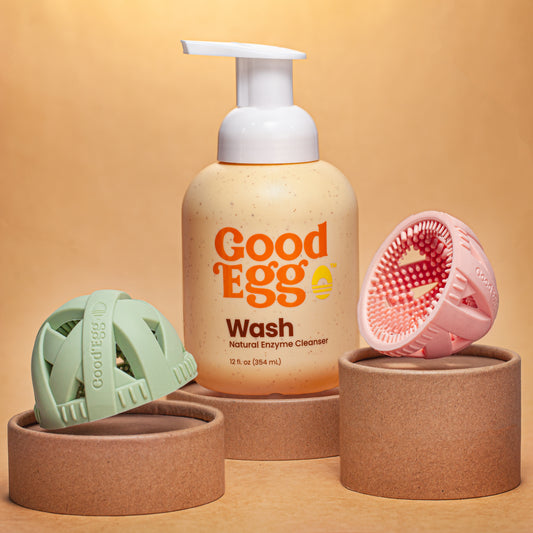
- Enzyme Application: Pump your Natural Enzyme Egg Cleaner directly into your scrubber. Our custom formula uses naturally derived plant enzymes to break down surface grime on contact. Unlike harsh chemical detergents or dish soaps, it is specifically engineered to clean the surface safely without ever penetrating or leaching through the shell, ensuring your fresh eggs stay pure and taste exactly like they should.
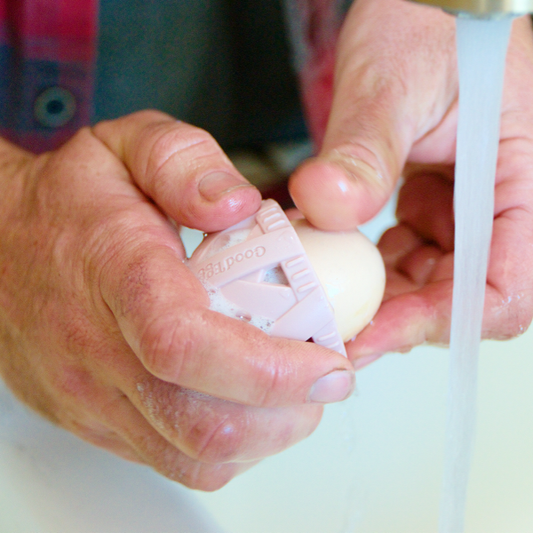
- Scrub: Insert the egg directly into the brush. Gently rotate to let the hundreds of cleaning nubs do the work. Pro tip: squeeze the brush together and use the exterior gripping ridges of the scrubber for any stubborn, extra-crusty spots.
- The Final Rinse: Give it a final pass under the warm water stream.
- The Dry: Pat the shell completely dry with a clean paper towel or rag. Never place a wet egg back into a carton, as trapped moisture against the shell can encourage mold growth.
-
Use or Store Them: If you're ready to cook, crack them straight into the pan! Otherwise, pop them immediately into the refrigerator to lock in that peak freshness.
Post-Wash Storage & Preserving the Peak
Once an egg is thoroughly washed and the natural bloom is removed, you are officially in a race against time and evaporation.
The 1-Day vs. 2-Week Rule
Dr. Brigid McCrea, a renowned poultry extension specialist, notes that an unwashed egg left sitting out on a warm kitchen counter (around 72°F) will lose just as much internal quality in one single day as a washed, properly refrigerated egg loses in two full weeks! If preservation is your ultimate goal, wash your eggs and refrigerate them right away.
The "Pointy Side Down" Secret
Always store your fresh eggs in the carton with the blunt end (the fat end) facing up. The internal air cell is located entirely at the blunt end. By keeping the fat side up, you prevent that air cell from putting unnecessary physical pressure on the yolk. This keeps the yolk perfectly centered and stops the egg from spoiling prematurely.
Prevention: How to Wash Less
The easiest way to wash an egg is to keep it from getting dirty in the first place! A solid egg-care routine always starts with great nesting box management:
- Most of your hens will lay their eggs by mid-morning. If you wait until 7 PM to do your daily collection, that fresh egg has spent many long hours being stepped on by muddy feet. Collect your eggs twice a day to drastically reduce breakages and poop incidents.
- Smart Bedding Choices: Hemp bedding (optionally with ceramic false eggs to encourage birds to lay in the nest) helps eggs stay significantly cleaner than traditional straw, which tends to harbor dampness, moisture, and hidden mold.
FAQ: Everything Else You Need to Know
Q: Can I use vinegar to wash my fresh eggs? A: We really don't recommend it. Vinegar is highly acidic. While it does kill some surface bacteria, that acid can actually thin and compromise the calcium structure of the eggshell, making it incredibly brittle and prone to hairline fractures.
Q: Does washing affect the overall taste? A: Only if you are using chemical dish soaps! Because eggshells are highly porous, washing them with standard kitchen dish soaps is a major food safety risk. Dish soaps utilize heavy surfactants designed to break down grease; however, these surfactants drastically lower water tension, allowing the soapy water to actively penetrate and leach straight through the shell's microscopic pores, ruining the natural flavor.
The GoodEgg all natural enzyme egg cleaner is completely unscented, plant-derived, and food-grade to ensure your fresh eggs actually taste like, well, eggs.
Q: My silicone brush is full of coop gunk, now what? A: That’s the beauty of the food-grade silicone design. Simply flip the brush completely inside out, give it a quick rinse, and it’s good to go! They are also dishwasher safe, so you can toss it into the top rack of your dishwasher every once in a while for extra peace of mind. Its 100% silicone design is naturally hydrophobic and anti-microbial, so it’s built to be easily sanitized daily.
Clean Eggs = A Happy Homestead
At the end of the day, washing your fresh eggs isn't just about making your kitchen counter look pretty, it’s about the perfect intersection of flock biology and family food safety. By understanding the vacuum effect, choosing the right tools for your specific poultry breeds, and sticking to a warm-water routine, you’re providing the absolute cleanest, safest food for your kitchen table.
Ready to give your daily harvest a serious upgrade?
Shop Our Full Collection of Fresh Egg Cleaning Tools & Supplies
Grab a Flock Mama - Fresh Egg Scrubber 2-Pack
Refill Your Stash with an All-Natural Enzyme Egg Cleaner 2-Pack Refill